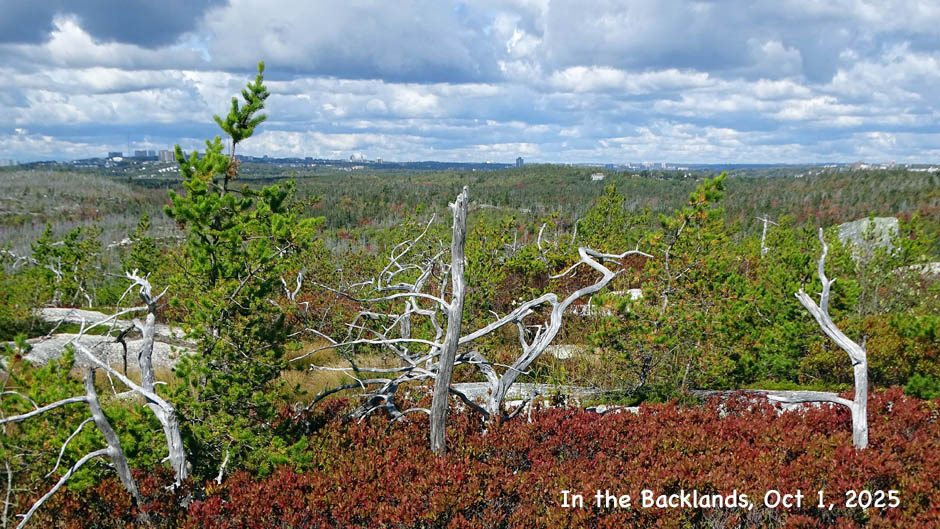
The JP/BC Barrens as we (Hill and Patriquin, 2014) have described them* correspond more closely to NS Forest Vegetation Type OW1 as described by Neily et al., 2023 (and see JP/BC Barrens – relationship to NSFVT OW1 on this website).
OWI is an “Open Woodlands” Vegetation Type which is defined as “Stands in an open woodland condition where natural disturbances or site have limited the establishment of trees to less than 30% crown closure or stands with excessively stony, steep slopes of colluvium interspersed with pockets of talus”.
Below is a screen capture of the two pages from Neily et al., 2023 describing OW1:


Jack Pine/Broom Crowberry Barrens (Hill and Patriquin 2014)
In this VT, Jack Pine occurs (i) as single or a few gnarled trees growing in cracks on rock barrens, (ii) in smallish (10-50 m across) treed patches with Jack Pine alone or dominated by Jack Pine and (iii) in more contiguous, larger patches interrupted by rock barrens or wetlands. Tree canopy cover ranges from less than 10% percent to about 60%. Big-toothed Aspen is the most common other tree in most mixed stands, followed by Red Maple, Wire & Paper Birch, Red & Black spruce. (Additionally, Jack Pines occur singly and in clusters in the Red Pine/Jack Pine/Broom Crowberry VT, and isolated Jack Pines occur in the Birch/Maple/Aspen VT, usually adjacent to their occurrence on Jack Pine/Broom Crowberry Barrens.) Broom Crowberry and Huckleberry are the most common associated shrubs, the Broom Crowberry occurring in edge areas on shallower soils, often with Reindeer Lichen, while Huckleberry occurs on deeper soils, growing tallest (to circa 1.5 m) where there is more exposure to the sun. Sheep Laurel may also occur, and in wet pockets, Huckleberry is replaced by one or more of Leatherleaf, Rhodora, Inkberry.


