DRAFTING…
CONTENTS
1. General definitions/descriptions of “Pine Barrens”
2. “Pine Barrens” as a class
3. Corresponding communities in Ecological and Vegetation classification systems for Nova Scotia
1. GENERAL DEFINITIONS/DESCRIPTIONS
OF “PINE BARRENS”
| “Pine barrens, a type of coniferous savanna occurring on infertile (i.e., “barren”) soil” – Prescribed burn frequency, vegetation cover, and management legacies influence soil fertility: Implications for restoration of imperiled pine barrens habitat, K.M. Quigley et al. 2020 in Forest Ecology & Management |
| “Pine barrens are unique plant communities that occur on sandy, infertile soils with poor water-holding capacity and are characterized by low tree density with an understory of grasses, ericaceous plants, and fire-dependent species. Scattered throughout the Midwest and elsewhere in North America, these plant communities are important for recreation and cultural values, including gathering blueberries. They are also key to the health of many plant and animal species, including threatened, endangered, and sensitive species…” – Restoring Pine Barrens Habitat:Optimizing Soil Conditions with Prescribed Fire USDA Forest Service, 2020. |
| The Pine Barrens is an ecological term that is used to described habitats that are comprised of sandy nutrient poor soils, acidic water and soil and fire adapted plant communities. – Pine Barrens vs. Pinelands: What’s the Difference?, page on Pinelands Allaince website |
| “Pine barrens include an assortment of pyrogenic plant communities occurring on glacial outwash or rocky outcrops scattered along the Atlantic coastal plain from New Jersey to Maine, and inward across New England, New York, Pennsylvania, and the northern Great Lakes region.” – Why Pine Barrens Restoration Should Favor Barrens Over Pine. J.T. Bried et al. 2014 in Restoration Ecology |
| “Pine barrens, pine plains, sand plains, or pineland areas occur throughout the U.S. from Florida to Maine (see Atlantic coastal pine barrens) as well as the Midwest, West, and Canada and parts of Eurasia. A well-known habitat to North Americans is the New Jersey Pine Barrens. Pine barrens are generally pine forests in otherwise “barren” and agriculturally challenging areas. Such pine forests often occur on dry, acidic, infertile soils, and also include grasses, forbs, and low shrubs. The most extensive pine barrens occur in large areas of sandy glacial deposits (including outwash plains), lakebeds, and outwash terraces along rivers Botany: The most common trees are the jack pine, red pine, pitch pine, blackjack oak, and scrub oak; a scattering of larger oaks is not unusual. The understory includes grasses, sedges, and forbs, many of them common in dry prairies, and rare plants such as the sand-plain gerardia (Agalinis acuta). Plants of the heath family, such as blueberries and bearberry, and shrubs, such as prairie willow and hazel, are common. These species have adaptations that permit them to survive or regenerate well after fire. Fauna: Pine barrens support a number of rare species…”- Wikipedia: Pine barrens |
COMMENT on “Barrens” : The term “Pine Barrens” obviously implies the presence of Pines, i.e. species in the genus Pinus (Family Pinaceae), a fairly unequivocal criterion for calling a “Barrens” a Pine Barrens.
The “Barrens” part of the term is a noun based on the adjective “barren”, thus “Barrens” clearly implies a biological system of low productivity. The term “barrens” was apparently first used historically to refer to a tract of low productivity land. From www.etymonline.com
barren(adj.)
c. 1200, “incapable of producing its kind” (of female animals, plants), from Old French baraigne, baraing “sterile, barren” (12c.), perhaps originally brahain, a word of obscure derivation, possibly from a Germanic language. Its use in reference to males is rare. Of land, “producing little or no vegetation,” by late 14c.
As a noun from mid-13c., “a barren woman;” later “tract of more or less unproductive land.”
BARRENS. Elevated lands, or plains upon which grow small trees, but never timber. [Bartlett, “Dictionary of Americanisms,” 1848]
2. “PINE BARRENS” AS A CLASS
The term “Pine Barrens” appears in some formal vegetation or ecosystem classifications but not others which in fact include “Pine Barrens” as described above.
The terminology applied to these classifications can be complex and possibly confusing; some Ecological and Vegetation classifications for a particular country or region are quite distinct from each other, others are merged wholly or in part.
The most comprehensive system for classification of vegetation and/or ecosystems globally is the International Vegetation Classification applied by NatureServe:
The International Vegetation Classification (IVC) provides a comprehensive multi-level structure to describe and classify the world’s ecosystems.
The classification is based on vegetation and ecological criteria, including vegetation growth forms and structure, plant species, and ecological characteristics such as site, disturbance, bioclimate, and biogeography. – SOURCE: NatureServe: International Vegetation Classification A Catalogue of Global Ecosystem Diversity Also view Data Coverage
NatureServe provides mapping and related info. on Species and on Ecosystems; the Ecosystem names are derived from the most characteristic plant species, but other (ecological) factors are involved in delineating each ecosystem or each level in the ecosystem classification.
The Classification Levels are
1 Class
2 Subclass
3 Formation
4 Division
5 Macrogroup
6 Group
7 Alliance
8 Association
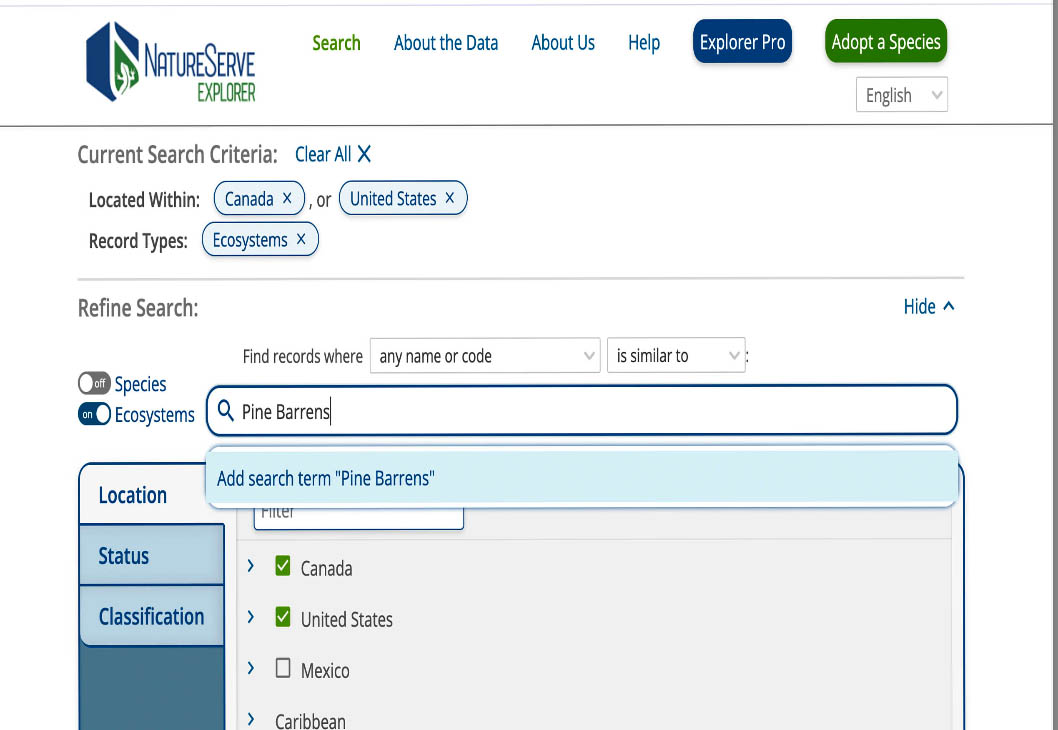
Screencapture of the top of the NatureServe Explorer Search Page. Click on image for larger version
I conducted a search on NatureServe Explorer for Ecosystem Records for the U.S. and Canada for which any Ecosystem name or code is similar to “Pine Barrens” (see image at right)
4 Group, 9 Alliance and 41 Association Records met these criteria; examples of the Group records are shown below:
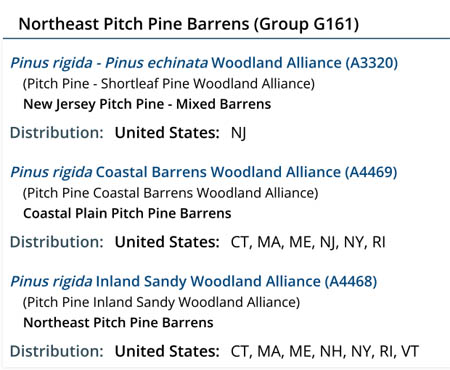
Screenshot
View the complete search results: NServePineBarrens7Nov026
These records provide (among other info) the geographic location of each Ecosystem and for the Group and Association records, the NatureServe Conservation status. Some Summary Stats:
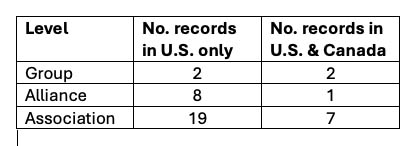
Table 1. Number of Pine Barrens Locations in U.S & Canada. There were no records which applied only to Canada. 41 Association Records were listed, but those within wetland Alliances (16) are excluded in these stats, e.g. Pine Barrens Bog Association (in the Chamaedaphne – Gaylussacia dumosa / Carex striata Open Bog Alliance) – to be consistent with the general descriptions above of “Pine Barrens” being dry or having soils with poor water-holding capacity. A distinction is sometimes made between “Dry Barrens” and “Moist Barrens” – so the stats above can be considered to apply to “Dry Pine Barrens”
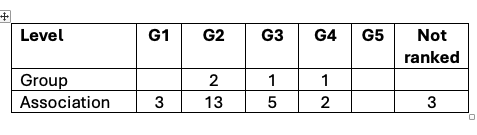
Table 2. NatureServe Conservation Status: Number of Records in each of 5 categories. G1:Critically Imperiled, G2:Imperiled, G3:Vulnerable G4:Apparently Secure, G5: Secure. View more about Conservation Status
The Locations in Canada (Table 1) occurred in Manitoba, Ontario, Quebec, New Brunswick.
Only 2 of the 27 Records (7%) which were ranked for Conservation Status had a G4 Apparently Secure, or G5: Secure Conservation Status; 25 of 27 records or 93% of the Records were for Ecosystems considered at Moderate (G3), High (G2) or Very High (G1) Risk. Thus, as a generalization, it could be said “Most Pine Barrens Ecosystems in the U.S. and Canada are currently considered At Risk”
3. CORRESPONDING COMMUNITIES IN ECOLOGICAL & VEGETATION CLASSIFICATION SYSTEMS FOR NOVA SCOTIA
As noted above, Manitoba, Ontario, Quebec, New Brunswick are cited as locations of “Pine Barrens” in Canada byNatureServe (Table 1); none are listed for Nova Scotia. However there clearly are equivalents in the major land vegetation and ecosystem classifications applied in Nova Scotia currently. Those are
– Ecological Land Classification for Nova Scotia By P. Neily et al., 2017. 296 pages. Published by Nova Scotia Department of Natural Resources; and the related
– Ecological Landscape Analysis Reports
Ongoing. Published by Nova Scotia Department of Natural Resources/ (These are reports for individual Ecodistricts)
– Barrens Ecosystems in Nova Scotia: Classification of Heathlands, and Related Plant Communities by C. Porter et al., 2020, 72 pages. Published by Nova Scotia Department of Lands and Forestry and Saint Mary’s University.
– Forest Ecosystem Classification for Nova Scotia (2022): Field Guide by P. Neily et al., 2023, 331 pages. Nova Scotia Department of Natural Resources and Renewables
The only mention of “Pine Barrens” in these publications is to two Ecosystem “Elements”* cited in the ELA report for the Western Barrens Ecodistrict 770 (PDF):
– Pine Oak Barrens, a “Matrix element” occupying 33,173 ha or 43.0% of the Ecodistrict
– Spruce Pine Barrens, a “Patch element” occupying 32,649 ha or 42.4% of the Ecodistrict
*View What is an Element (a sub-page of this page) for an explanation of “Element”
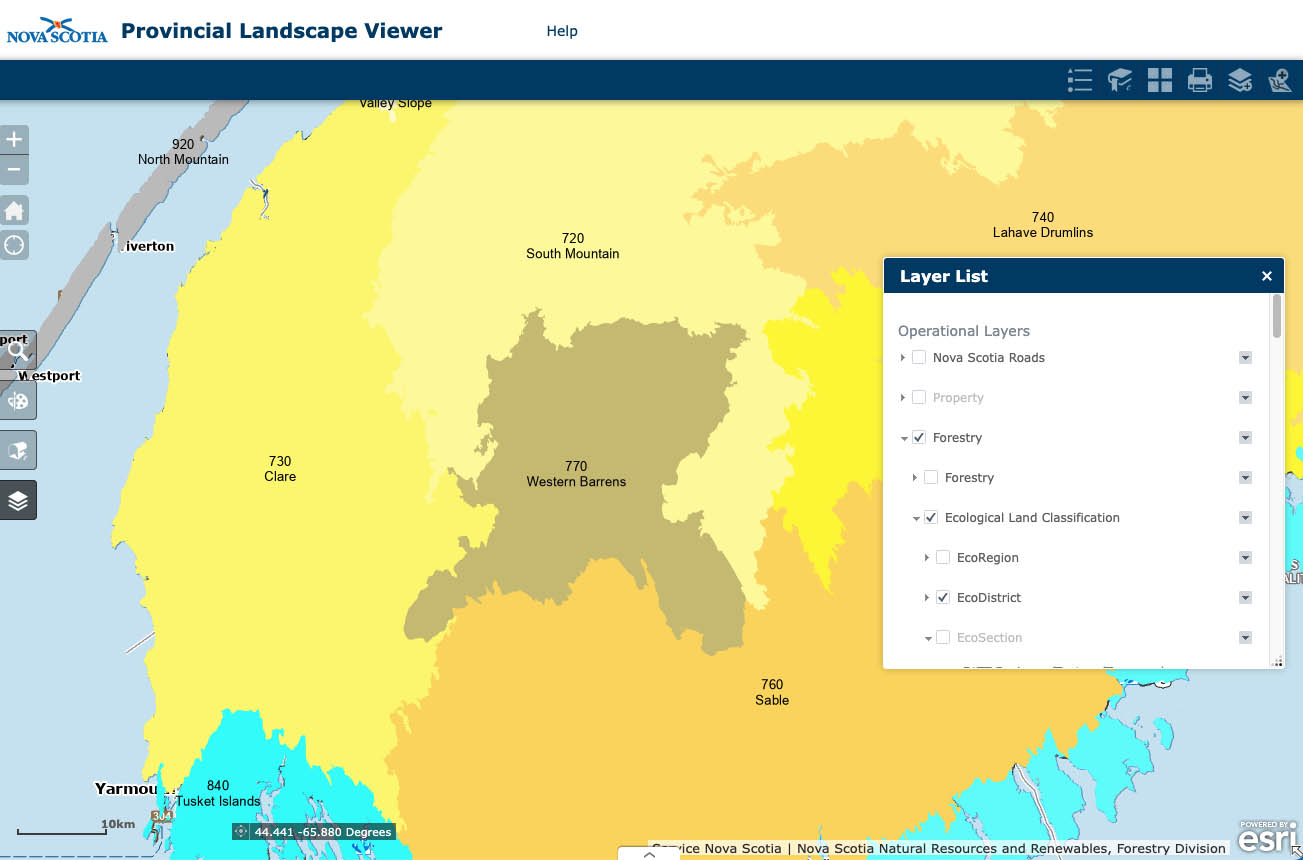 Boundaries of Ecodistrict 770 in SW Nova Scotia. From NS Provincial Landscape Viewer (accessed Nov 8, 2026) |
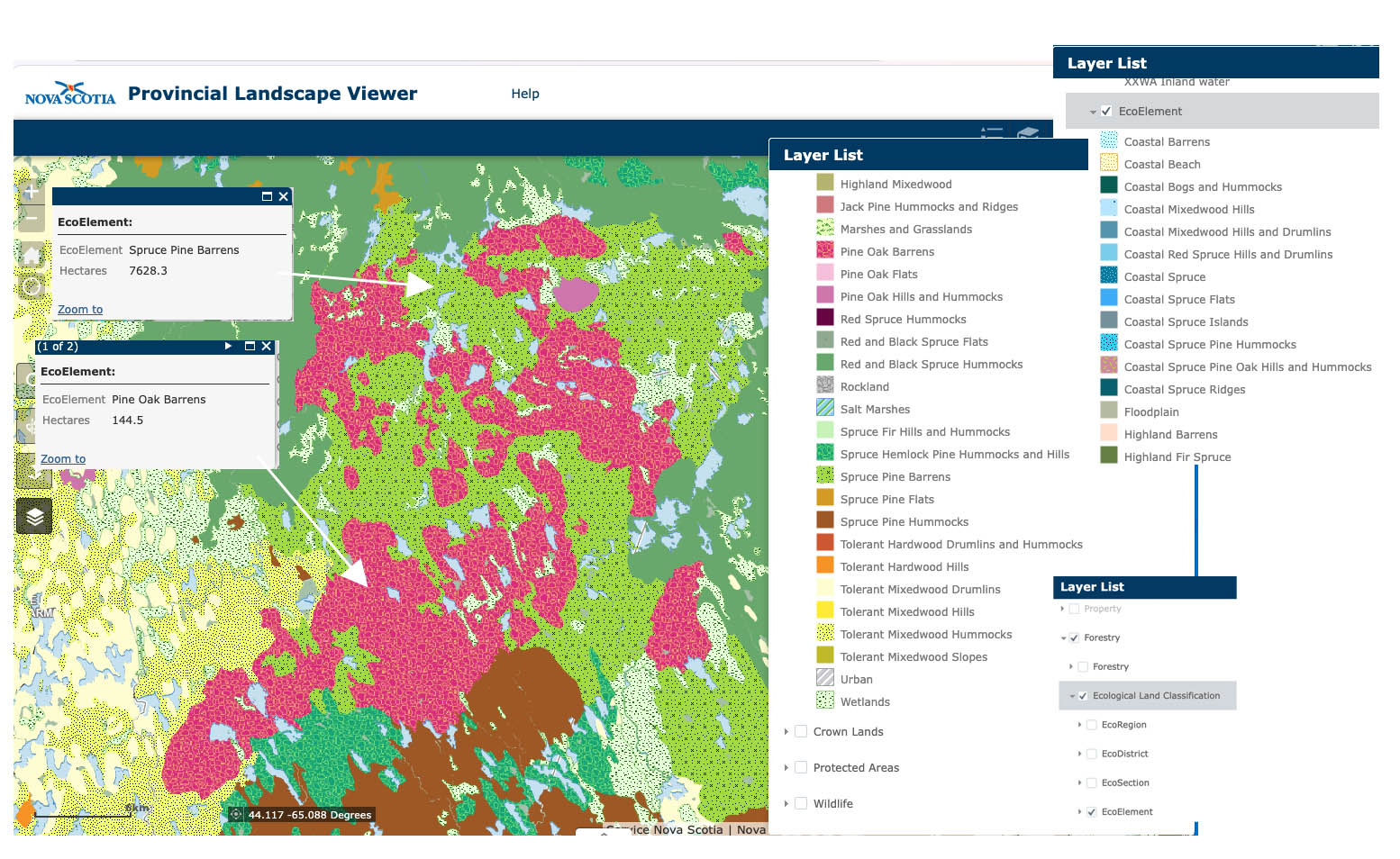 Distribution of Spruce Pine Barrens and Pine Oak Barrens Elements in Ecodistrict 770. From NS Provincial Landscape Viewer (accessed Nov 8, 2026) |
Associations with Pines cited in “Barrens Ecosystems in Nova Scotia: Classification of Heathlands, and Related Plant Communities” (C. Porter et al., 2020)
“Barrens are a type of ecosystem characterized by harsh climatic and or edaphic conditions, and by low shrub dominated plant communities. These communities are largely composed of shrub species belonging to the heath family, Ericaceae, and the heath like Crowberry family, Empetraceae.”
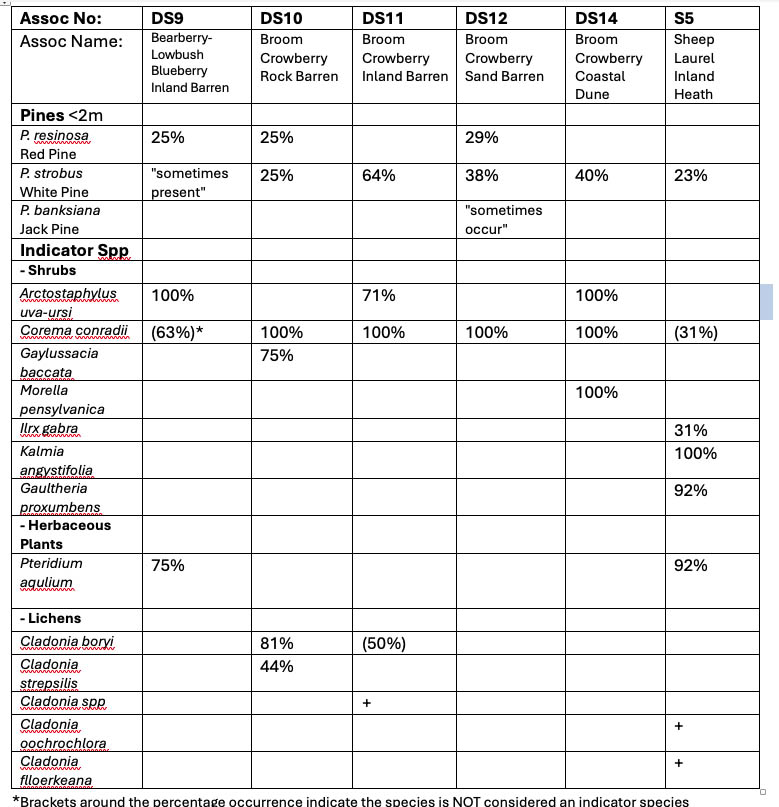
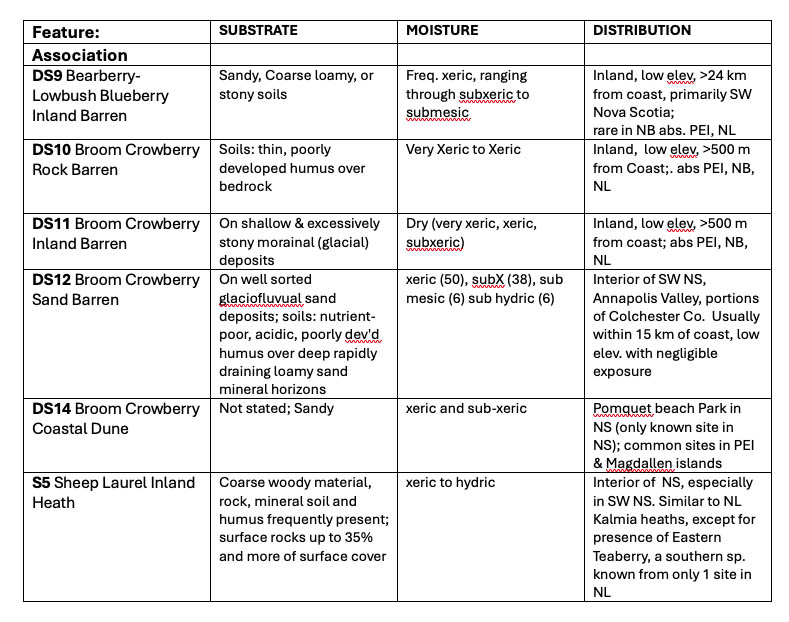
One of more species of Pine (Pinus spp), all less than 2 m height, are present in 6 of the 22 distinct barrens Associations described by Porter et al. 2020. Characteristic species and and info. of the substrates, moisture regimes and geographic distribution of these 6 Associations are tabulated the two tables below.
Screenshot
Screenshot
Likely Candidates for “Pine Barrens” in the Forest Ecosystem Classification for Nova Scotia” (Neily et al., 2023)
Content to be added
& What’s the status of the informally named
“Jack Pine/Broom Crowberry Barrens” in the Backlands?
Content to be added